My Love,
There are moments when the world feels like too much.
When your chest tightens. Your breath shortens.
When everything in your body is braced — even your sleep.
This is not weakness.
This is your nervous system whispering: I need rest.
Not just sleep. Not distraction. But rest — the deep, slow kind. The kind that heals.
This is where restorative yoga begins.
Not as effort. Not as performance. But as a practice of receiving.
It is the art of being held — by cushions, by breath, by time. It is a quiet return to yourself, not through doing, but through un-doing.
The Nervous System’s Quiet Plea
We are not designed to be constantly alert.
And yet — we live in a culture that never stops asking.
Emails. Deadlines. Notifications. Family. Performance. Care. Proving. Producing.
Over time, our sympathetic nervous system — that primal fight-or-flight response — stays switched on. Our bodies pump out adrenaline and cortisol. Our heart races even when there’s no danger. Our digestion slows. Our thoughts race. Our breath shallows. Our jaw clenches. We begin to live inside the tension.
But there is another way.
The parasympathetic nervous system — often called “rest and digest” — is where healing happens. This is where your body mends, your breath deepens, your mind clears, and your heart softens.
Restorative yoga is the key that unlocks this sacred shift.
What Makes Restorative Yoga Different
This isn’t a flow.
This isn’t a workout.
This isn’t something to “get better at.”
This is a practiee.
You enter a pose and stay — five, ten, even twenty minutes. You are supported by bolsters, blankets, blocks, pillows —a soft structure to rest inside.
You breathe.
You feel.
You let the body know: you are safe now.
And the nervous system responds — not with adrenaline, but with ease.
The Body’s Response to Being Held
Here’s how restorative yoga supports you, from skin to soul:
🜁 Activates the Parasympathetic Nervous System
The body shifts from “do” to “be.” Blood pressure lowers. Cortisol decreases. Muscles soften. The heart slows. The body reclaims its rhythm.
🜁 Unwinds Physical Tension
Chronic stress lives in the shoulders, the jaw, the low back, the belly. With props, the body feels safe enough to melt — without needing to stretch, push, or prove.
🜁 Deepens the Breath
As you slow down, your breath naturally deepens. The diaphragm expands. Oxygen flows. Each inhale nourishes. Each exhale lets go.
🜁 Invites Emotional Unravelling
Stillness is not just physical. In this quiet, the emotions you’ve been holding at bay begin to rise — to be seen, felt, and released.
🜁 Restores Your Capacity to Feel
There is something holy in doing nothing. In letting yourself be, just as you are. Restorative yoga reminds you that healing begins not with effort — but with allowing.
What the Research Reveals
Science, like spirit, confirms the truth:
🜃 Cortisol levels drop.
Lower cortisol means less anxiety, better immunity, improved weight balance, and deeper rest.
🜃 Heart Rate Variability (HRV) improves.
A high HRV means your body can shift between stress and calm more gracefully — the signature of resilience.
🜃 Sleep deepens.
Restorative practice before bed leads to longer, more restorative sleep — your nervous system’s nightly reset.
🜃 Symptoms of anxiety and depression ease.
The stillness invites emotional regulation. You begin to witness your inner state without being ruled by it.
A Practice for Your Sanctuary
You don’t need a studio.
You don’t need silence.
You don’t even need time — only intention.
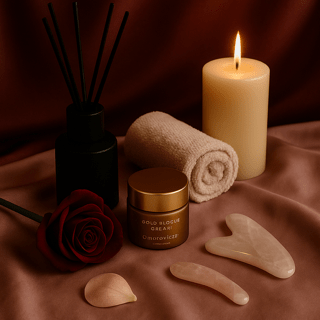
Create a nest. Low light. Blankets. Support beneath you. Music if it calls. Lavender or sandalwood. Turn your phone away. Let this be yours.
Here’s a simple sequence to support the nervous system in moments of overwhelm:
Supported Child’s Pose
Kneel, bolster or cushion beneath you.
Fold forward. Let the head turn to one side. Arms soft.
Stay for 5–10 minutes.
Let the breath move down into your belly. Let the earth hold what you can’t.
Reclined Bound Angle Pose
Lie back, soles of feet together, knees open.
Support the knees, spine, and head.
Place one hand on the heart, one on the womb or belly.
Stay 10–15 minutes.
Inhale: I receive.
Exhale: I release.
Legs-Up-the-Wall or Over a Bolster
Lie down, legs up a wall or resting over a chair or cushions.
Arms wide. Eyes soft or closed.
Stay 10–20 minutes.
Feel the blood return to the heart. Feel your mind descend.
Savasana with Blanket Weight
Final rest. Lie down. Place a folded blanket over the pelvis or belly — a gentle weight, a grounding anchor.
Stay as long as you need.
Let your breath become the only thing you follow.
Building Resilience Through Practice
Restorative yoga is not just about relief.
It’s about rewiring your relationship with stress.
The more you practice, the more quickly your body learns the way back. You begin to notice tension as it forms. You recognize the early whispers of burnout. You soften before collapse.
🜂 You cultivate emotional regulation — staying steady even when life isn’t.
🜂 You nurture self-trust — knowing how to return to yourself.
🜂 You strengthen the mind-body connection — feeling the truth of your own needs, moment by moment.
And above all:
You remember that rest is not indulgence. It is return.
A Final Whisper
You do not need to earn this.
You do not need to finish the list, please everyone, solve the problem, or be strong.
You need only this:
To lie down.
To breathe.
To be held — by the mat, by the props, by the breath, by yourself.
Let the nervous system feel your stillness. Let it remember its rhythm. Let it remember you.
This is not surrender in defeat.
This is surrender as self-respect.
Let rest become your revolution.
With softness and spine,
Lily
If this practice speaks to you, I offer guided sessions on YouTube — soft practices, meditations, and seasonal stillness for the nervous system. Come rest with me, if you like.
YouTube: Serenity in Motion Channel
 Serenity In Motion
Comments