Part of the Softening into Wholeness and Sacred Unfolding collections
There is a quiet pressure that exists in many practices.
To stay longer.
To hold on.
To endure.
To prove something through completion.
The timer has not ended, so you remain. The teacher has not cued the transition, so you wait. The pose is meant to be held for five minutes, so you tell yourself that leaving at three would somehow count less.
Even in gentle spaces, performance can follow us in.
We bring into the body the same beliefs we carry elsewhere: that pushing through is admirable, that discomfort should be tolerated, that stopping early means weakness, that discipline matters more than response.
These ideas can be so familiar that they feel natural.
But the body often knows something different.
Sometimes the body recognises before the mind does that enough has been reached.
A hip begins to grip rather than open.
The jaw tightens.
The breath becomes strained.
Numbness replaces sensation.
Agitation rises.
The nervous system shifts from softening into bracing.
Outwardly, you may still be “doing the pose.”
Inwardly, the conditions have changed.
This is an important moment.
Because many people override it.
They stay to be good. Stay to finish properly. Stay because leaving would need justification. Stay because they do not yet trust the first whisper of no.
But that whisper matters.
The body often speaks quietly before it needs to shout.
A subtle urge to reposition.
A sense that the edge has become too sharp.
A feeling that what was nourishing a minute ago is no longer nourishing now.
Listening here is not failure.
It is relationship.
Coming out of a pose early is not automatically avoidance, just as staying longer is not automatically growth. Context matters. Honesty matters. Attunement matters.
Sometimes staying is medicine.
Sometimes leaving is.
The skill is learning the difference.
This can be surprisingly emotional, because many people have histories of ignoring themselves. They were taught to minimise discomfort, override needs, smile through strain, remain available past capacity, continue after the body had already said enough.
When you begin to honour a boundary in practice, it can touch much more than the pose.
You are rehearsing a new pattern.
I notice myself.
I respond to myself.
I do not need external permission to adjust.
My limits are not an inconvenience.
That is powerful work.
The next time you practise, notice the moment your body asks for less.
Not dramatically. Often it will be subtle.
A breath that shortens.
A shoulder that starts to guard.
An impulse to shift position.
A clear internal sense that the nourishing part has passed.
When it comes, experiment with honouring it.
Come out slowly. Add support. Change the shape. Rest. Choose another posture. Pause entirely.
Do it without apology.
Do it without turning it into a debate.
Do it without needing to earn the right.
Because your boundaries belong in your practice too.
Not just in relationships.
Not just at work.
Not just in the big moments of life.
Here as well.
On the mat. In the pose. In the quiet space where no one may even notice but you.
Especially there.
Your body does not measure practice by how long you endured.
It measures whether it was met with safety, truth, and response.
And sometimes the most transformative thing you can do is soften sooner.
Leave before strain becomes betrayal.
Adjust before pain becomes the price.
Listen before the whisper becomes a shout.
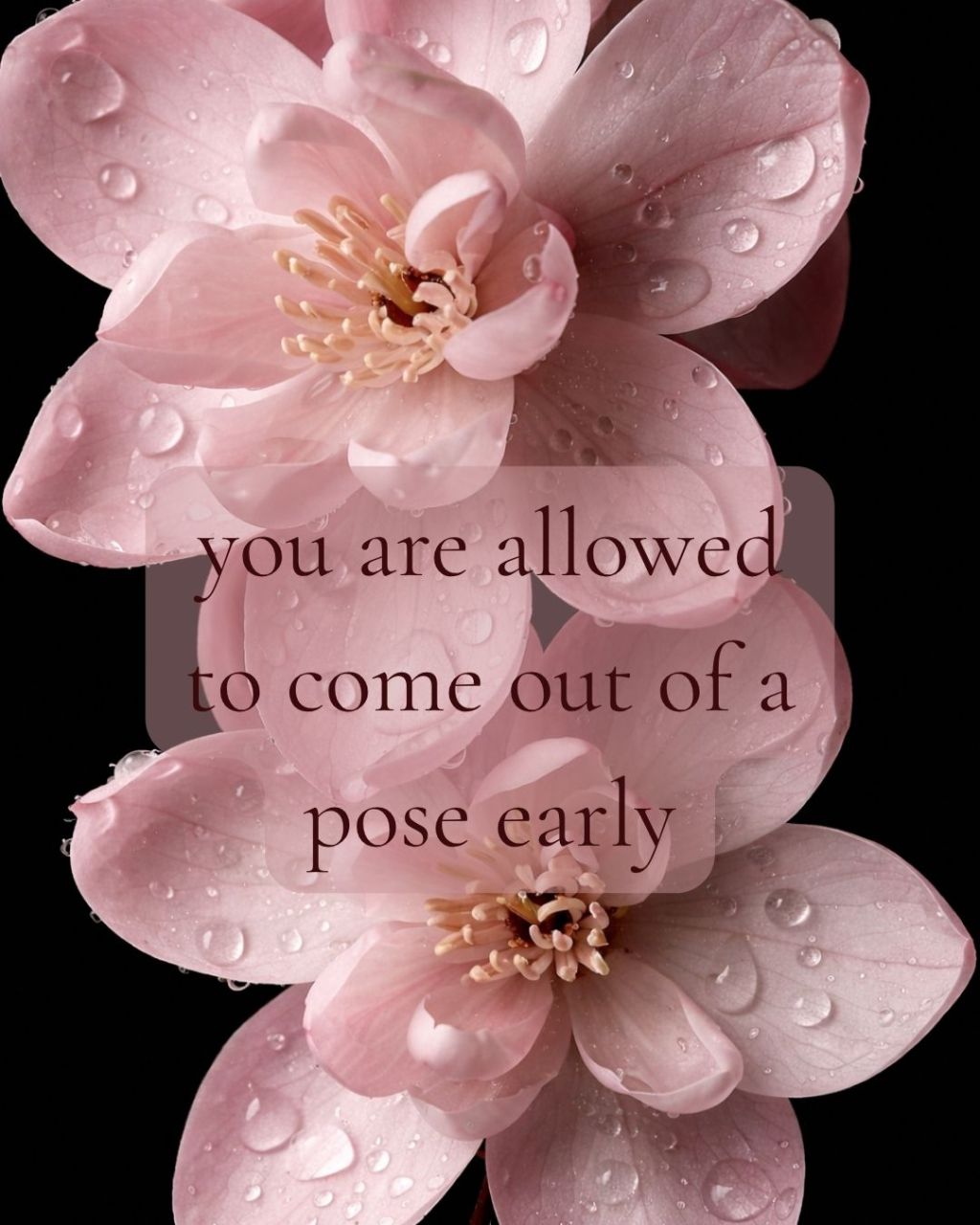
You are allowed to come out early.
You are allowed to trust the knowing that arrives before explanation.
And that trust, practised gently, tends to reach far beyond the mat.
To stay with this month’s rose more deeply, the September 2026 – The Fading Rose Workbook is waiting for you here – a quiet companion of prompts, rituals, and reflective practices to help you soften into the theme at your own pace.
 Serenity In Motion
Comments